The Robot in the Kitchen: Is Automated Cooking Finally Coming to America?
At American Coney Island in downtown Detroit, something unusual now rolls between the tables. A robot—provided by robotics integrator RobotLAB—transports Detroit Coneys to waiting customers. Staff punch in a table number, load the food, and the robot delivers. Owner Grace Keros is clear about what it means: "Is the robot here to replace an employee? Absolutely not."
Three hundred miles east, at WellSpan York Hospital in Pennsylvania, the future looks different. There, a fully autonomous robotic kitchen called Fresh Take Eatery opened in March 2026, capable of producing hundreds of made-to-order meals—gnocchi pesto, chicken teriyaki rice, custom salads—with no human hands touching the food. The 400-square-foot unit doubles dining capacity for a campus of 10,000 people, using four cooking modules and 80 fresh ingredients managed entirely by robotic arms.
These two scenes capture the state of food automation in early 2026: delivery robots are already familiar, but fully autonomous cooking is arriving fast. For franchise operators watching thin margins and chronic labor shortages, the question is no longer if but when and how.
What's Real Now
The restaurant industry has grown savvier about separating automation hype from genuine utility. What's working at scale today falls into three categories.
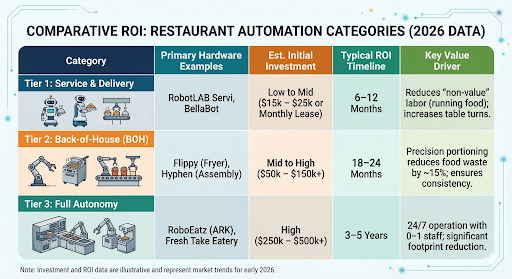
Delivery and serving robots are the most mature. RobotLAB, which operates 36 locations nationwide, has deployed hundreds of units across restaurants, hotels, and airports. The model is straightforward: robots handle repetitive transport of food from kitchen to table, freeing staff to focus on customer interaction. "We have robots that can deliver endlessly," says CEO Elad Inbar. "People don't want to do these jobs."
Back-of-house automation is accelerating. White Castle's "Castle of Tomorrow" prototype includes robotic fry cooks. Chipotle and Cava jointly invested $25 million in Hyphen, a platform that automates bowl and salad assembly. Dave's Hot Chicken is building its tech stack around AI voice ordering, kiosks, and kitchen robotics as it scales past 300 locations.
Fully autonomous cooking remains the least common but fastest-improving category. The WellSpan hospital installation represents a breakthrough: a commercial-grade, full-service robotic kitchen operating in a real-world, high-volume environment.
The Economic Imperative
The case for automation has shifted from experimental to existential. Post-pandemic labor shortages aren't temporary; they're structural. The entry-level worker has fundamentally changed. As Inbar puts it, "the workforce is no longer willing to sacrifice their time for repetitive, manual tasks they perceive as beneath their potential."
Meanwhile, the costs operators can control have narrowed. Rent is fixed. Energy prices are market-driven. Interest rates are elevated. "This leaves the savvy strategist with only one primary battlefield: the 'unit-level' costs of labor and food waste," Inbar notes. "Robotics has moved right into the center of this field."
Globally, 73% of restaurant operators plan to invest in AI and automation by 2025, according to Restolabs. Early adopters report food cost reductions of up to 15% and revenue forecasting accuracy improvements of 22%.
The RobotLAB Model
What distinguishes RobotLAB in this rapidly crowding field is its focus on end-to-end integration. The company doesn't just sell robots; it partners with businesses to assess needs, deploy systems, train staff, and provide ongoing support. With 36 U.S. locations and a franchise network ranked #3 in America by The Franchise Consulting Company, RobotLAB is building a national footprint for robotics deployment.
The company's portfolio spans more than 50 robot types—cleaning bots, delivery bots, security patrol robots, and now humanoid prototypes like BroBot™, launched February 2026. But its core value proposition remains practical: solving labor gaps with reliable, measurable automation.
The Franchise Perspective
For franchise owners, the automation question carries unique weight. Multi-unit operators must balance consistency across locations with the flexibility to test new technologies. The current landscape offers a roadmap.
Kiosks and digital ordering are table stakes. Modern self-order kiosks now function as revenue optimization tools, not just labor savers, with average order value lifts of 18-26% through AI-driven upselling.
Drive-thru voice AI is in active pilot. McDonald's continues expanding AI across operations, while partnerships like SoundHound and Acrelec aim to bring voice ordering to scale. The key is robust fallback to humans—customers won't tolerate frustration for long.
Kitchen robotics require careful evaluation. The Hyphen platform and robotic fry stations promise transformative efficiency, but they demand sustained volume, streamlined menus, and strong internal tech champions. For most franchisees, the near-term opportunity lies in augmenting existing staff with task-specific robots, not wholesale kitchen replacement.
Cleaning and facility robots offer the fastest ROI. Autonomous scrubbers and vacuums handle hundreds of thousands of square feet daily, operating overnight when labor is scarce.
Redeployment, Not Replacement
Across every case study, one theme recurs: automation is about freeing humans, not eliminating them. The dystopian vision of robots displacing workers is giving way to a more nuanced reality—machines handle monotonous tasks while people focus on connection.
As Inbar frames it, "The goal? Liberate your skilled, trusted, and loyal staff from the mission-critical drudgery that machines were born to handle. When a robot scrubs floors, it's not just saving money—it's saving the human smile, the warmth, the irreplaceable connection that turns a transaction into an experience."
Is Cooking Autonomous Coming Soon?
The WellSpan hospital kitchen provides the clearest answer yet: fully autonomous cooking is here, in limited but operational form. The technology works. The ingredients are fresh. The meals are hot. The constraints of space and labor that have held back institutional foodservice are being systematically dismantled.
For franchise operators, the implication is clear. The building blocks of automation—delivery bots, cleaning robots, kiosk ecosystems, kitchen assistants—are already deployable and increasingly affordable. The fully robotic quick-service restaurant may still be a few years from widespread adoption, but the foundation is being laid now.
The operators who thrive in 2026 and beyond will be those who view automation not as a replacement for their people, but as a strategic investment in their people's potential. The robots are coming to kitchens across America. The question is whether franchise owners will lead that transition or be dragged through it.
As RobotLAB's Inbar puts it, "The time to adapt is here. No longer are the days where we thought this was only a temporary glitch."
Footnote:
Sources Used and curated from:
RobotLab Website, Detroit News (Feb 2026), Fox Business (Jan 2026), York Daily Record / Benzinga (Mar 2026), CB Insights, Tech Tracker (Jan 2026),
About the Author
Jewan "Jack" Tiwari is a seasoned Franchise Consultant, Business Broker, and M&A Advisor based in the Washington, D.C. metro area. Serving the Mid-Atlantic region, he specializes in the full business lifecycle—from initial acquisition and SBA financing to scaling through franchise development and securing high-valuation exits. For strategic advisory, contact him at Jack@TheFranchiseConsultingCompany.com.