The Woman Who Forgot to Feel Sorry for Herself

What I Witnessed From the Audience
I was sitting in the audience when I first heard Seema Govil tell her story. She had a few minutes to present. I expected what you usually expect from someone describing a cancer journey — the diagnosis, the fear, the fight. That's the honest arc of it, and no one would fault her for telling it that way.
That's not the story she told.
Here's what stopped me. When most people go through something as hard as cancer, every ounce of energy turns inward — and it should. The treatments. The scheduling. Managing food, managing your body, managing your own survival. That's not selfishness; that's what the disease demands of you. It takes everything.
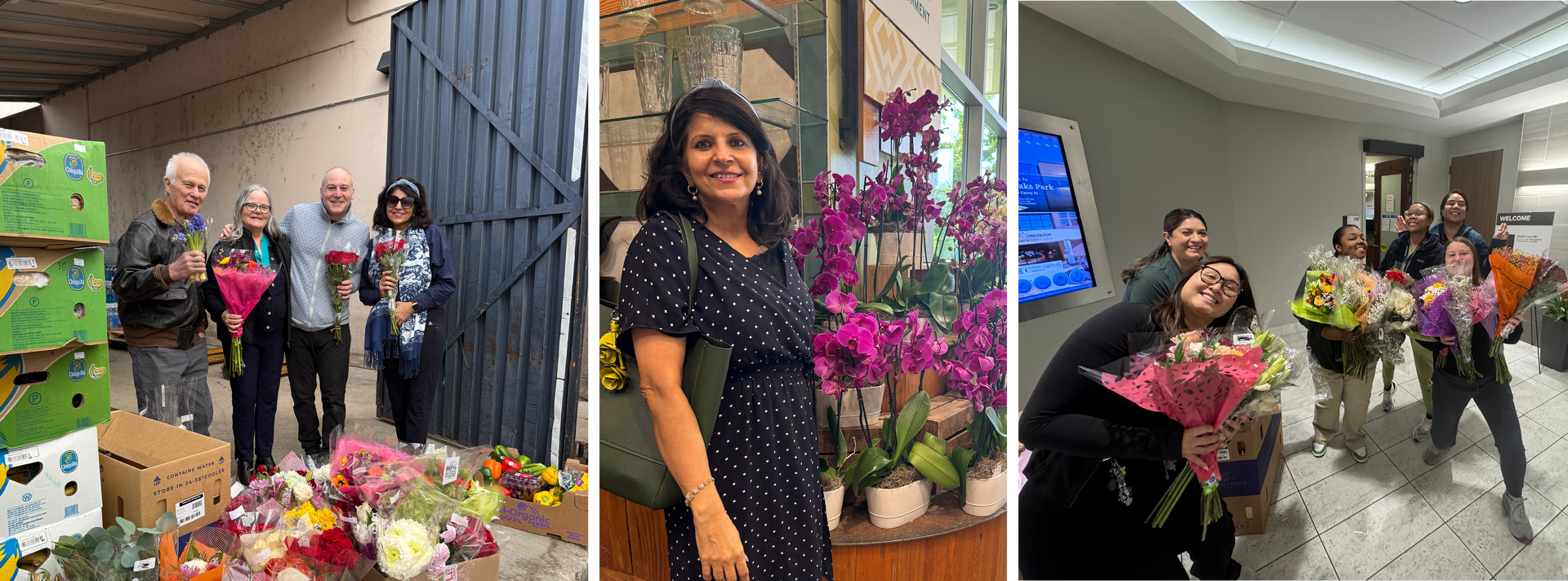
Seema did the opposite. In the middle of her own treatment, she started thinking about the other patients. The ones in the infusion chairs beside her. The ones who looked how she felt. And instead of waiting to get well before helping anyone, she began bringing flowers into the clinics — while she was still in treatment herself. Watching her describe it, I kept reaching for a word she would later name in her own language: seva — service offered without expectation of return, the kind you give not after you are whole, but as part of becoming whole.
There was a poem, too. She had written it during the peak of her own treatment, and one day a nurse read it aloud while Seema sat waiting. It stayed with the nurse. When Flowers for Joy began, it was the nursing staff who suggested attaching the poem to the deliveries — because coming from a patient who had lived it, the words carried a kind of encouragement no card from a stranger ever could. The poem itself reads like a quiet prayer — surrender, letting go, a sense of connection to something larger than the illness — the contemplative register of the tradition she was raised in, offered to strangers in their hardest hour.
Sitting there, I remember thinking: how does someone do that? How do you have anything left to give when the disease is taking everything? She'll tell you she didn't even notice she was doing something unusual — it was only afterward, when person after person pointed it out, that she understood how rare it was. That, to me, is the whole story. Not the illness. The instinct to turn outward when everything was pulling her in.
That instinct has a lineage. Seema's background is in philanthropy — long before Flowers for Joy, she supported Akshaya Patra, the Indian nonprofit whose mechanized kitchens cook staggering quantities of food to feed underprivileged schoolchildren, on the simple principle that a child who eats well learns well. In 2022 she traveled to India to make a documentary about that work. Service wasn't something she picked up during cancer. It was already who she was. The disease just revealed it.
It's fitting, then, that she found her way to The Franchise Consulting Company, where she has been a consultant since 2022 — a world built around the idea that a good model, once proven, can be handed to others and grown. That's exactly what she's doing with Flowers for Joy.
I'll admit I didn't stay in my seat as a spectator for long. Something about what she was building pulled a few of us in, and found ourselves inspired to help — brainstorming how the initiative could grow city by city, what it would take to bring it to New York, how to give it a home online. I took on building the website and whatever else Seema needs to carry this forward. It stopped being a story I watched and became one I'm part of.
Here's how it actually works, because the discipline of it matters. The clinics don't permit outsiders, so the flowers are delivered to the nurses, and the volunteers and nursing staff bring them the rest of the way to patients in chemotherapy and radiation. Every week. Never a missed Monday since November 2024. It began in Austin, and it's expanding now — in New York, Seema's daughter and a friend's daughter are leading the effort.
But the number that stays with me isn't the deliveries or the cities. It's the one I did the math on from my seat in that room: one person, mid-treatment, deciding that her hardest season would be about someone else's comfort.
And from where I was sitting, that was the most remarkable thing I'd seen in a long time.
Flowers for Joy is powered by the nonprofit
MDJunior.org. To collaborate or follow along, reach Seema at Seema@thefranchiseconsultingcompany.com or find the initiative on Instagram at
@flowersforjoy24.
ABOUT THE AUTHOR
Ozzie Grupenmager is a franchise consultant with The Franchise Consulting Company and founder of NextGen Business Solutions, a business coaching and franchise advisory firm. A former COO in the franchise industry and CIO at a global advertising network, he built a franchise system from the ground up as a franchisor. His background spans franchise development, multi-unit operations, branding, marketing strategy, and business intelligence. He is also the founder of VyBeos, an AI and technology company that powers NextGen's platforms and develops its own applications. Ozzie advises entrepreneurs, investors, and emerging brands on franchise ownership, operational systems, and scalable growth.